Working with a vintage unprinted pattern, if you’re lazy.

0
1962 Spadea/Chanel unprinted pattern

1962 Spadea/Chanel unprinted pattern

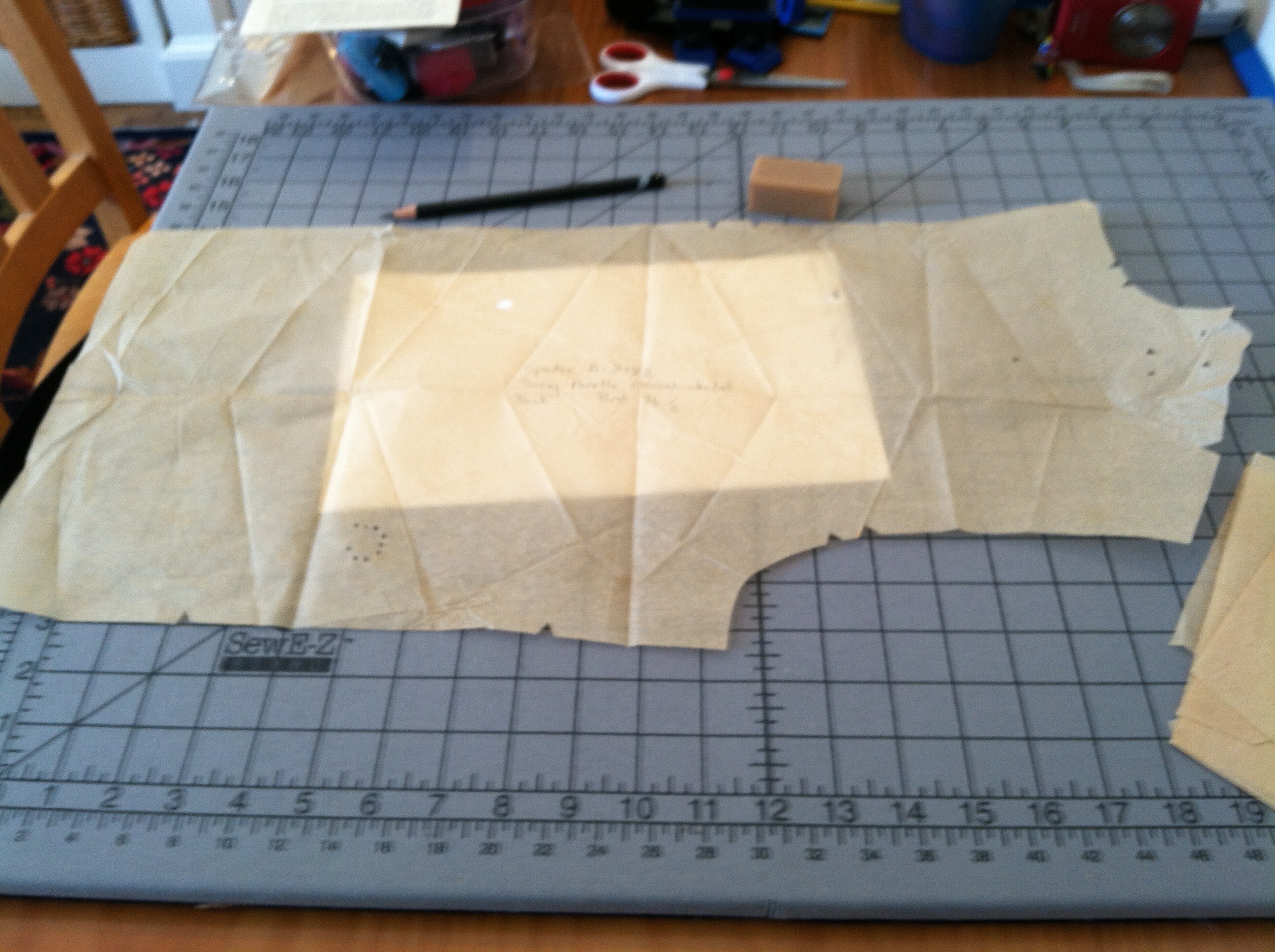
If you sew from vintage patterns, you may have been nonplussed to open that package and see absolutely nothing printed on the pieces, like in the photo above. Printed patterns only came into vogue in the 50s, and before that people needed to follow the notches and dots cut into the pattern to find their way. The Spadea company continued to hand-cut their unprinted patterns well into the 60s.

Above is a piece of the Spadea/Chanel jacket pattern I wrote about in a previous post. The instructions included with the pattern explain what the markings mean.  Each pattern piece has a letter made of small dots punched in it, to identify the back, front, sleeve etc. The notches are small “v” shapes on the side, three large dots indicate the fold, two large dots indicate the grainline, and medium and small dots are used in the instruction to indicate buttons, buttonholes, ease lines etc.
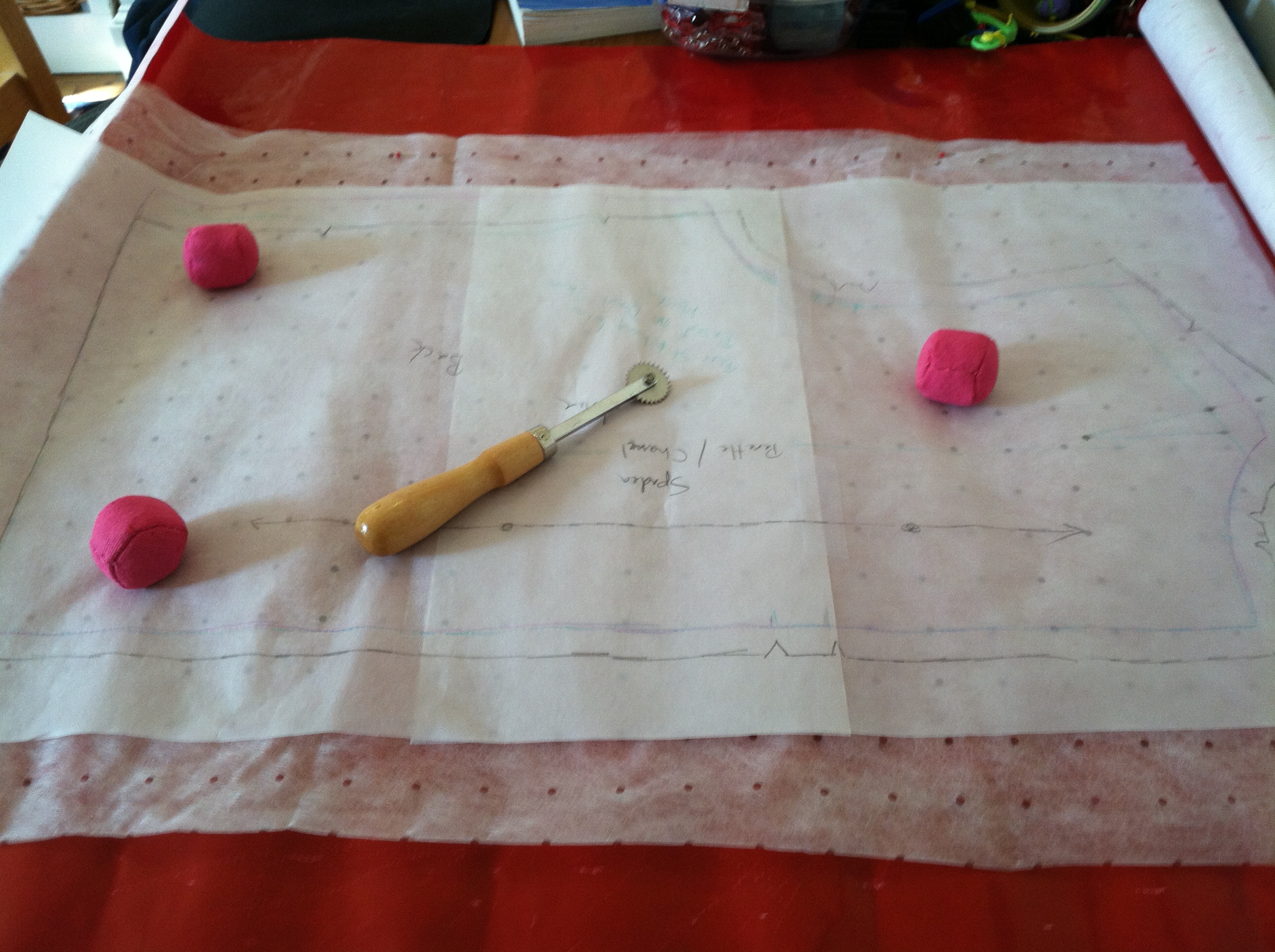
Marking pattern on to "Kwik Trace" muslin

Marking pattern on to “Kwik Trace” muslin

The first thing I do when I open an unprinted vintage pattern is write the pattern number, name and original bust size measurement on each piece so they don’t get mixed up with other patterns. Since I was using a rare vintage pattern, I traced it onto tracing paper and put the original away. Then I compared the pattern piece with a pattern from a previous jacket I made to make some fit adjustments. You can do this with a pattern block or sloper if you have one. (Those are basic fitting patterns some people make for themselves to fit patterns more quickly. So far I’ve been too lazy to make one.)

I then used a large piece of tracing paper (from the http://www.richardthethread.com/  website in LA) and a tracing wheel to copy the pattern onto my “muslin” version of the jacket. (Though in this case I’m using Kwik Trace tracing fabric rather than actual muslin, again being lazy.) The downside of Kwik Trace is that it’s unwoven and doesn’t have a grain, so I wouldn’t recommend it for projects where you need to know how the fabric will behave, such as a bias cut dress.
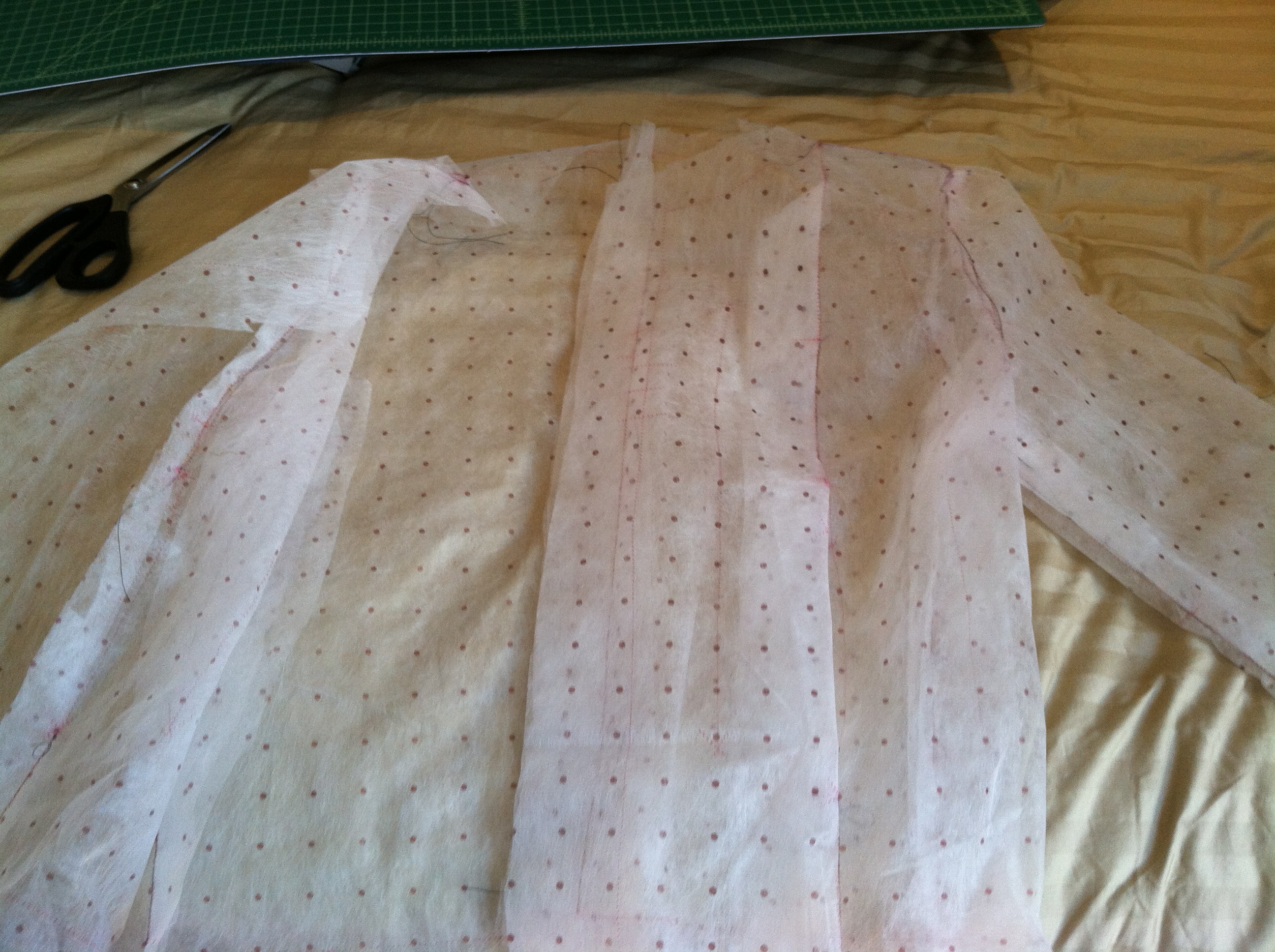
Completed "muslin" of jacket

Completed “muslin” of jacket

I cut out the pieces and constructed the muslin loosely using the method outlined in Susan Khalje’s “Couture Dress” course on Craftsy. (Okay, I skipped a few steps, but you get the idea.) I’ve recommended that course in previous posts, and it really helps with vintage projects like this. http://www.craftsy.com/class/The-Couture-Dress/53?_ct=sbqii-sqjuweho-qbb&_ctp=53,1

Once I tweaked the fit, I marked any changes on the Kwik Trace with a sharpie and took the “muslin” apart. Those pieces now became my pattern. At this point I wrote the pattern number and name on each piece and indicated that it had been fitted for me, in case I wanted to reuse it.

Cutting the fabric with large seam allowances

Cutting the fabric with large seam allowances

I pinned the pattern pieces on my fabric and then cut loosely around them to leave plenty of seam allowance. Boucle like this unravels in a huge hurry, and by the time you’re ready to finish the seams, you may have already lost more than 1/2 an inch.

Thread tracing the seam line

Thread tracing the seam line

At this point, if you follow Susan’s Khalje’s instructions in the Couture Dress course, you are supposed to “thread trace” (loosely baste with contrasting silk thread) around all of the seam lines to mark the seams on the front and back. This is a great idea! But I can’t face it at this point in the construction! (Because I’m lazy.) So, despite the fact that Susan warns against this, I marked both sides of my fabric with tracing paper, which I then could not get out of the fabric. Fortunately my fit was pretty good, so I just stitched inside the line and the marks ended up inside the seam allowance. I did thread trace the armscye and sleevecap as it makes it a million times easier to line up.

How about you? Have you ever worked with an unprinted pattern? How did it go? Leave me a comment, and a link if you have one. I’d love to see your projects.

Till next time… (I used to work in TV so I feel like I need a sign-off line) “May your bobbins be full and your tension even?”

Claire Schaeffer: Godmother of Haute Couture Sewing #2

7

photo (12)
If Susan Khalje is the hands-on “Godmother of Haute Couture”, who learned her craft making confections for Bridezilla, then Claire Schaeffer is the historian, whose in-depth study of haute couture techniques have made her books a must-have for my sewing library.

Her “Couture Sewing Techniques” book, in particular, describes just about every haute couture technique that a sewing enthusiast will encounter in a lifetime (or the half-life of your fabric stash, which is 9 million years…). Fitting, sleeve-setting, hems, buttonholes, pockets, jacket tailoring (including Chanel-style jackets), fabrics, pressing etc. are all covered in painstaking detail. Here’s where you can find it on Amazon:

http://www.amazon.com/Couture-Sewing-Techniques-Revised-Updated/dp/1600853358/ref=pd_bxgy_b_img_z

If you go to the Threads Magazine website, there is a series of videos by Claire Schaeffer illustrating the techniques from the book, which I highly recommend. The hand-stitching tutorial in particular I found very useful. If your hand-sewing skills are not that strong, it’s worth it for you to watch this video and practice before you undertake sewing a Chanel-style jacket. You need to subscribe to the Threads website for access to the videos, or buy the DVD:

http://www.threadsmagazine.com/item/23016/couture-techniques-workshop-basics-with-claire-shaeffer

Claire Schaeffer just published a comprehensive book on the history and making of the Chanel-style jacket, entitled “The Couture Cardigan Jacket: Sewing Secrets from a Chanel Collector.” The enclosed DVD walks you through every step of her method of making a jacket. Here it is on Amazon:

http://www.amazon.com/Couture-Sewing-Cardigan-secrets-Collector/dp/1600859550/ref=sr_1_1?s=books&ie=UTF8&qid=1384778985&sr=1-1&keywords=claire+schaeffer

(I have a confession to make at this point. I love Claire Schaeffer’s books, but just looking at the zillions of steps she outlines in her Chanel-style jacket method gives me so much anxiety that I want to go bake cookies instead.) Fortunately, Lizzie of The Vintage Traveler, a favorite blog of mine, has written a nice rundown of the book and video, which you can find here:

http://thevintagetraveler.wordpress.com/2013/10/11/currently-reading-and-viewing-the-couture-cardigan-jacket-by-claire-shaeffer/

One person who made a very pretty jacket using Claire’s pattern is seamstress Ann Rowley. During construction, she took a series of very helpful photos illustrating every step:

http://www.flickr.com/photos/7370831@N07/sets/72157630204914658/

And here’s a link to reviews from patternreview.com by people who have completed jackets from this pattern.

Vogue 8804 http://sewing.patternreview.com/patterns/54069

If you are someone who can fathom spending the time it takes to hand-sew a couple of intricate quilts and fashion them into a tiny jacket, then Claire’s method may be for you. There’s a lot of basting involved, and people who have made the pattern say it takes more than 100 hours start to finish. The result is a meticulous and authentic jacket that’s a little conservative for my tastes, but may be just what you’re looking for.

Why Chanel lining is like lingerie…

2
Chanel/Spadea jacket lining

Chanel/Spadea jacket lining

A quick look at the interior of the finished jacket. The lining is a silk crepe de chine by Carolina Herrera, found on emmaonesock.com, a website that offers, among other things, leftover yardage from high-end designers. After I finished the interior steps outlined in the previous post, I constructed the lining and fell-stitched it to the front facing, neckline, center front and hems, enclosing all of the busy work inside.

I always like the “surprise” of the bright linings stitched into these vintage Chanel jackets, which remind me of how chic, put-together French women have their look thought out down to their meticulously chosen, gorgeous (and mostly hand-wash only) lingerie.

I personally witnessed the French ritual of selecting lingerie one Saturday afternoon in the tiny, tony Eres shop on Paris’ rue de Cherche Midi. While I was attempting to squeeze my American behind into the largest size of their minimalistic beachwear, the saleswoman, in typical French fashion, would periodically throw the curtain wide open and loudly give her unvarnished opinion of how each style was or wasn’t working on me.

The scene was different in the neighboring dressing rooms, though, which all had men stationed outside. I finally realized that the French women in the changing rooms were all trying on various 200 Euro bras made of about 20 centimeters of tulle, then getting the yay or nay from their lovers outside the curtain, who were standing all of 3 feet away from me while participating in this discreet form of foreplay.

Um, where was I? The chain weight on the hem of the jacket is just the best cheat, which I found at Mood Fabrics’ new locale in L.A. It’s a chain that is cleverly woven into a twill tape.  So rather than the oh-so-laborious hours sewing on of the traditional Chanel chain weight, when you are so over making the jacket, you just machine the twill tape on about 1/2 below the unfinished hemline, then turn up the hem and catch-stitch it in place before fell-stitching on the lining right above the chain. It’s worth putting on the chain to counterbalance the lightness of the jacket, and this method makes it much easier.

All that’s left is a row of hooks and eyes down the front, then the joy of wearing it.

Jacket interior–hidden luxury

4

Image

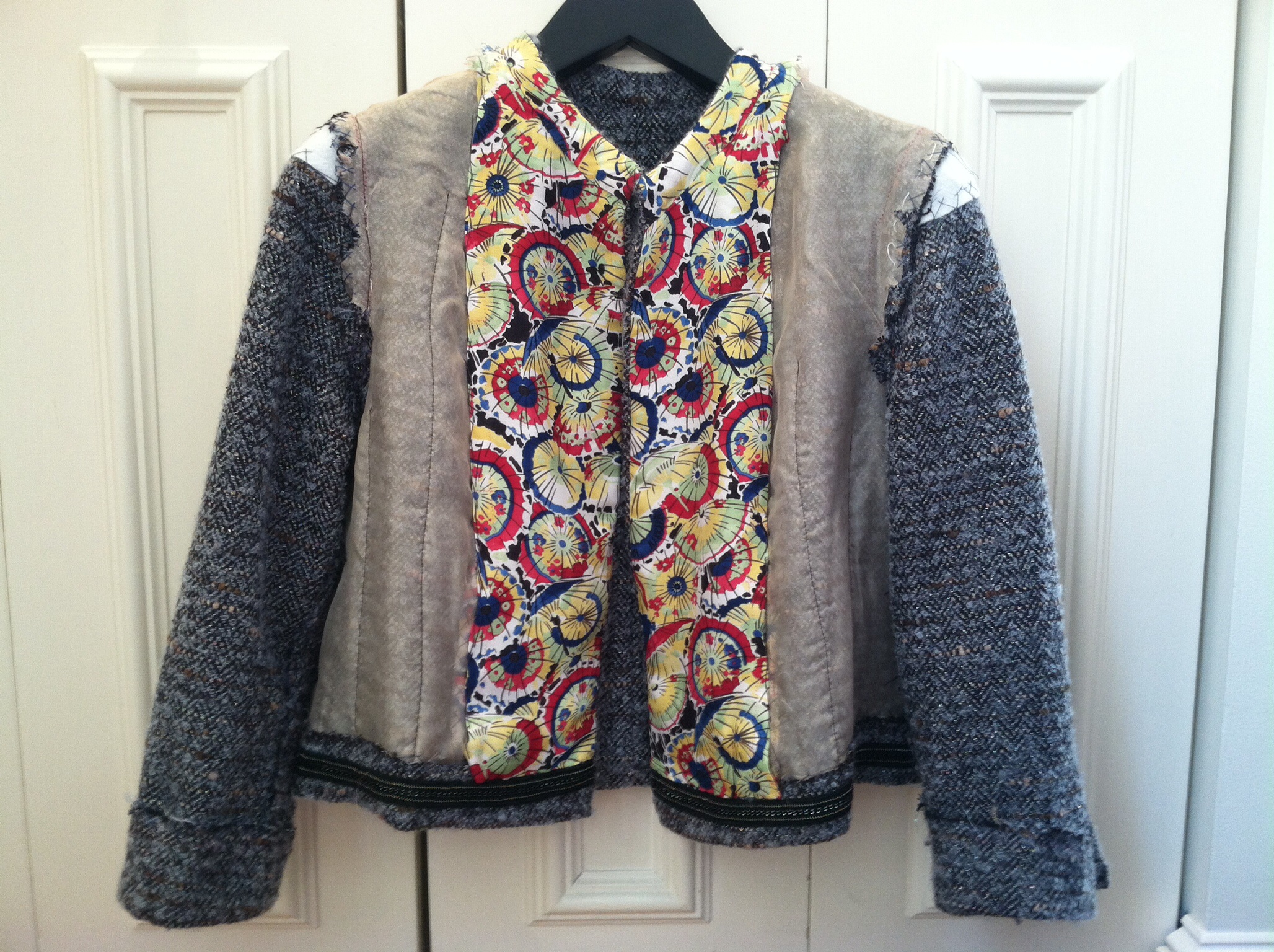
Here’s a closer look at the interior of the jacket, before it was fully lined with silk crepe de chine. The blue/gray fabric is the exterior “fashion” fabric, and the colorful fabric is the silk lining front facing. The beige fabric is the hidden luxury of this method. Rather than using modern fusible interfacing, the jacket is underlined and quilted with silk organza, a soft, sturdy secret weapon that gives the jacket shape without stiffness. The white crescents on the top of the sleeves are a soft wool “sleevehead” that give the sleevecap that “couture pop” without shoulder pads. (Although in this 60s version, the sleeve fits pretty tightly in the armhole, without the modern “poof” I’m not that into.)

To avoid having any topstitching visible on the exterior, which to me looks mass-market, I catch-stitched all of the hems and seam allowances down by hand. This highly-tedious process is tempting to skip, and yet I believe it’s the most important thing you can do to give it that haute couture je ne sais quoi. It’s hard to describe, but this secure and highly elastic stitch gives the jacket a soft movement, making it look like it’s held together without thread. Yet it controls the interior, so the seams never roll or unravel.

Traditionally, haute couture Chanel jackets have the colorful silk lining quilted directly onto the fashion fabric, without an underlining, but not all of them were made that way over the years. Personally I prefer this method because the organza underlining gives you a stronger jacket that’s still soft and light. And your last step, which is to tightly fell-stitch the colorful lining all around the interior edge of the jacket, completely covers the organza, the quilting, the seam finishes, and a multitude of sins.

Choosing the fabric for the Chanel/Spadea

1
Chanel/Spadea Jacket materials

Chanel/Spadea Jacket materials

I’ll admit that finding the elements for a Chanel-style jacket is the most fun part, because you’re still living in a dream. While still stitching away on my second Chanel jacket during a holiday trip to Paris, I had the bad fortune to visit Janssens et Janssens fabric shop (janssensparis.com). The fact that it is a block down from Louis Vuitton should have tipped me off that the neatly arrayed bolts of fabric shelved floor to ceiling would start at 200 Euros a yard and go up from there. The slogan on their website loosely translates to “In the heart of Faubourg Saint Honore, the boutique for creative and elegant women who understand the price of fashion.” Talk about French understatement.

Nevertheless, the women who worked there were unfailing pleasant and helpful as I woefully eyeballed the bespoke tweeds, beaded confections and artfully printed cashmere challis. Just when I’d convinced myself that I couldn’t justify the yardage price vs. husband will kill me cost ratio, I saw an unmarked table of half-price remnants, which included the blue/gray boucle above. The fabric is a wool herringbone weave, with slubs of beige woven throughout, jazzed up with shiny silver threads. With a meter and a third left, the woman assured me that I had enough for a “jacket” (said with a knowing look). Sold.

There were a number of other people in the shop at that time, one of whom was an elfin French male dressmaker, who proudly told an Asian couple there, in English, that his jacket was “‘omemade”. He said he had once worked for Chanel, and as I was selecting trim for the jacket from the equally pricey yet out of control trim rack, he decided in that very French way to stop me from making any grievous aesthetic errors. The trim I’d picked, with the black gimp edges and beige velvet ribbon, was “too taupe” and just wouldn’t do. The saleswoman, seeing a large sale go out the window, insisted that my choice was a good one. “Ah” he said, in that French tone that means, “I’m going to compromise but still pretend you’re doing it my way,” “Here’s how you do.” He then told me to pull several strands from the fabric, two or three at a time, put them in a darning needle, and weave them in and out of the trim over the velvet ribbon. As a well-behaved non-confrontational American in Paris, I nodded my head and thanked him, thinking, “I’m not doing that.”

As my items were rung up, I heard him gossiping in French with the saleswoman, and was able to catch the following…that made-to-measure haute couture Chanel suits were starting at 40,000 Euros ($55,000 depending on the day) and the one for Madame So-and-So cost 50,000 Euros. Having made several of the jackets now using the haute couture method, I can just about understand how a hand-made suit could be as complex and costly as an Audi. And as an Audi owner, I can attest that the jackets last longer.

When my jacket was constructed, and it came time to trim it, I looked at the trim and realized that indeed it was “too taupe.” So I got out my darning needle and wove in those threads from the fabric. My French friend, you were so right.

Pattern by Chanel

1

Here’s what inspired me to give another tedious, labor intensive Chanel Jacket a go:

1962 Chanel pattern released by Spadea

1962 Chanel pattern released by Spadea (photo (c) Julie Eilber, 2013)

It’s a 1962 Chanel jacket pattern released by the Spadea pattern company. Spadea was a mail-order company that sold sewing patterns, via articles in local newspapers across the country, from 1950 through the 1970s. What made Spadea unique was that the patterns were drafted directly from designer garments currently retailing in U.S. stores. So a housewife in rural Ohio or Salt Lake City could use their patterns to recreate replicas of garments by American Look designers such as Claire McCardell, Ceil Chapman, Tina Leser, Joset Walker, Clare Potter, or international designers such as Biki of Milan, Pierre Cardin, a young Lagerfeld (designing for Tiziani) and the Queen’s couturier, Norman Hartnell. The range of designers fashions represented in the Spadea line is astonishing. In recent years these patterns have become highly collectible in the vintage sewing world, some going for hundreds of dollars.

Look closely, and you’ll see that this particular pattern says “Chanel design reproduced by Suzy Perette.” In those days before off-shore manufacturing, U.S. fashion companies would license designs from French companies and manufacture replicas of the garments in the U.S. for the domestic market. One of those companies was Suzy Perette, who created U.S.-manufactured garments by Euro designers such as Givenchy and Chanel.

This jacket pattern has the hallmarks of Chanel jackets of that era: the high, tight armholes, the bracelet-length sleeves with vents, the center front panels that hang in parallel lines from the neckline, the small Mandarin collar that stands up just so, the slightly boxy, cropped “Jackie” fit.

Even though I was sick to death of making jackets, when I found this pattern online late last summer I just couldn’t resist.


Chanel Jacket #4

2

10597356983_069525009b_z[1]

I’ll start at the end and work backwards. Here’s my 4th, best, and hopefully final Chanel jacket all made in the past 18 months. It was constructed using what appears to be the only officially licensed Chanel jacket pattern to ever be released–a 1962 pattern by the Spadea company. (More on the pattern in the next post).

The whole thing took me at least 100 hours.